
Coach Walters is quickly becoming one of my favorites on this staff ... Stanford alum who speaks of Husker Football tradition with a reverence - any player on this team with a pulse and desire for greatness will buy into this.


That genuine respect will easily be seen with the players on the team as well as recruits and their families. Looking forward to seeing what this looks like during the season.Coach Walters is quickly becoming one of my favorites on this staff ... Stanford alum who speaks of Husker Football tradition with a reverence - any player on this team with a pulse and desire for greatness will buy into this.

Please, Coach Frost, bring back the physicality and toughness I loved watching under TO.
Couple it with speed, speed, speed, and "Whoa, Nellie!"
The numbers backed up the struggles: 81.3 rushing yards per game, which ranked 127th of 128 NCAA Division I teams; and dead last at 2.7 yards per carry. Most frustrating was that the former three-star recruit and his teammates couldn’t point to why they struggled this mightily.
“We were the weakest part of the team,” the lineman said. “The best way I can say it is we were disjointed as an offensive line.”
But the player — UCF right tackle Wyatt Miller — grins as he tells the rest of the story. About how Scott Frost and his staff arrived in the offseason before the 2016 season to begin the turnaround from 0-12 to 13-0 in two years. How his position coach, Greg Austin, built a relationship with each lineman before rebuilding the unit as a whole.
“I tell you what, what Coach Austin did for us as an offensive line — and Coach Frost, too — is just made us not be afraid of failing, not being afraid of making a mistake,” Miller said a few days before UCF completed an unbeaten season by winning the Peach Bowl. “I think that made the biggest difference. He really just fine-tuned us. You say you take your car in for a checkup and they end up fine-tuning it and it runs like it never has before. He’s done a great job of that and molding us into young men.”
But Austin lights up when discussing messages he couldn’t deliver in Orlando. An unheralded member of Nebraska’s 2003 class recruited by longtime Tom Osborne assistants Milt Tenopir and Dan Young, the Texas native embraced the Husker line tradition and eventually became a regular contributor. He knew names of former legendary Huskers at his position like Dominic Raiola, Zach Wiegert, Will Shields and Toniu Fonoti.
“This was O-Line University; we call this thing The Pipeline,” Austin said. “Well, let’s get it back there. And if we have an offensive line-dominant team — which those teams were … I guarantee we’ll be back where we need to be as a program. And it’s on us. It’s on our shoulders. It’s not on my shoulders, it’s on everybody’s shoulders in that room. And I tell them that every day, I start the meeting out with that every day. Because the standard is the standard.”
Austin quickly responds with a “hell yeah” when asked if he learned anything from the UCF transition that he can apply now. He incorporated a “movement playbook” last offseason, in which PowerPoint animations show players where their respective positions are supposed to go on a given play. These Huskers, who have never used such a tool, are incorporating it from the start.
Frost’s journey back to Nebraska has been well chronicled during the past four months. From Wood River to Stanford, back to Lincoln, on to NFL stops with the Jets, Browns, Patriots, Packers and Buccaneers, followed by assistant coaching jobs at Kansas State, Northern Iowa and Oregon before his miraculous turnaround from 0-12 to 13-0 in just two years at Central Florida.
It almost seems as if his path was predestined to lead back to Lincoln.
Frost has been impressive in many ways, but possibly the most impressive part is he has a plan. He knows what he wants and has a blueprint of how to get it.
He wants toughness like the Huskers had in the mid 1990s when they won three national championships in four years. He wants more reps in practice.
He believes in hard work. He believes in culture.

Some big buy in from the big boys, leaders in the trenches...
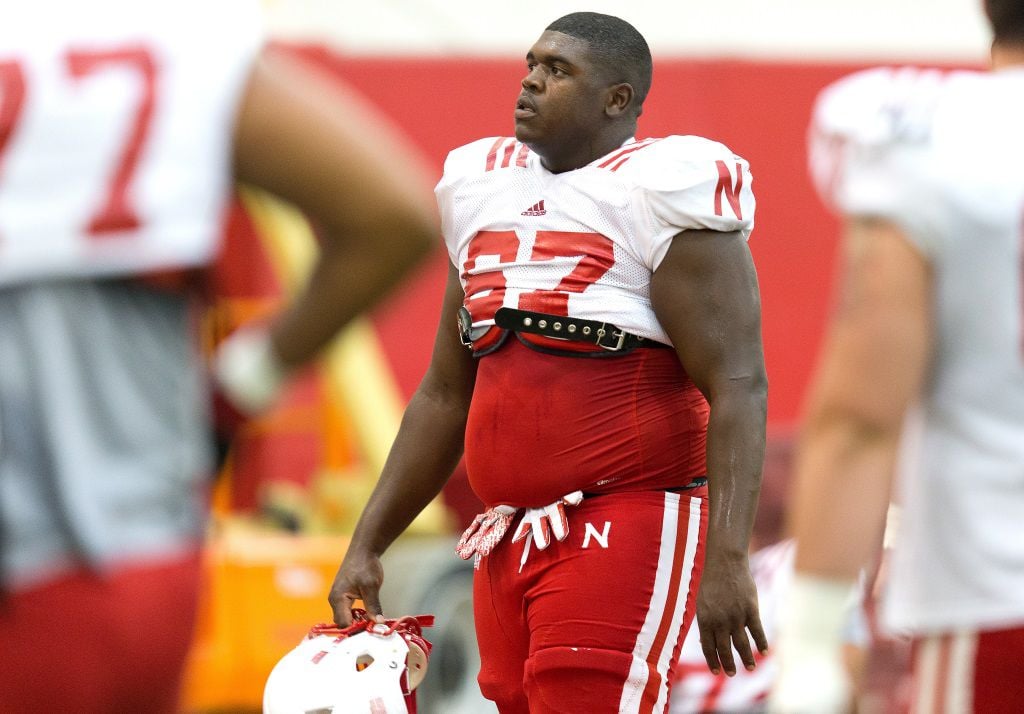
Stoltenberg said he also has liked what he’s seen from new defensive line coach Mike Dawson. With 19 years of coaching experience, including three at the professional level, Dawson has spent time reviewing Philadelphia Eagles film with the Nebraska defensive line. There are similarities in the 3-4 that the Eagles run, and Stoltenberg has appreciated the knowledge Dawson has brought to the table.
“It is kind of similar, the nuance of [Philadelphia’s] system. It has been really fun to learn from them and to kind of see the kind of stuff he’s done,” Stoltenberg said. “It is a lot different than the old defense, just in terms of responsibility and stuff like that. Not every defense is the same. It is fun learning a new system and kind of getting experience from Coach Dawson.”
Regardless of who you ask, nearly every response for who have been NU’s top player leaders this offseason has included senior nose tackle Mick Stoltenberg and redshirt sophomore defensive end Ben Stille.
Defensive coordinator Erik Chinander said the Gretna and Ashland natives emerged as some of the strongest voices on the team during winter conditioning.
“They're doing a great job of obviously doing what they need to do strength conditioning-wise, but also in a leadership role, grabbing a guy and maybe talking to him on the side and saying, ‘I’m not going to allow that to happen anymore,’” Chinander said. “They're going to be uber important to this team. Not even this defense, but on this team.”
Chinander - a native of Allison, Iowa, who was a walk-on offensive lineman at Iowa from 1998-2002 - has a true appreciation for the impact in-state players like Stoltenberg and Stille could have in establishing a strong culture within a program.
When pride and passion are driving forces in the locker room, Chinander said, everything else becomes that much easier.
“This program is built on kids like that,” Chinander said. “It has been for a long time, and anytime you can get a kid that's in-state that you evaluate and you think, ‘He is a guy that we want to scholarship,’ I think it’s not only a separator, it's a decision maker for us. It just matters more for those kids, like ‘I want to build this thing.’”

